Tuesday, November 10, 2015

STAYING INSIDE THE BALL: WHAT DOES IT REALLY MEAN?

jeter1

Over the past 18 years, if you have ever watched a game on TV that Derek Jeter was playing in, chances are that you have heard the announcers praise his ability to stay inside the ball.   Walk into a training facility or baseball camp, and we’d be willing to bet that you’ll see a drill that is meant to practice the skill of staying inside the ball.

Staying inside the baseball is one the most common things taught by coaches across the land, yet, it is by far, one of the most misunderstood concepts in the game today.  More often than not, coaches explain how to stay inside the ball by telling players to hit the inside part of the ball, and/or to try to hit the ball to the opposite field, regardless of where the pitch is located.  Only on the outside pitch is this kind of instruction correct, while for anything located on the other two-thirds of the plate, a forced, unnatural, pushing-type of swing is inadvertently being developed, where the result on the field will likely be a lot of lazy fly balls the other way, to go along with quite a few hand-numbing jam shots.

So what does staying inside the baseball REALLY mean?

Truth be told, the skill of staying inside the ball actually has very little to do with the ball itself.  Think about this for a second… Unless the batter is getting hit by the pitch, his hands will ALWAYS be inside of the baseball.  The idea of staying inside the ball actually is in reference to where the hands are relative the hitter’s body, rather than where they are relative to the ball.  To easily understand what exactly that means, we offer a simple two-part demonstration:

PART ONE

Stand up, facing a partner, raise and extend your arms straight out in front, at shoulder height.   Palms up or down, in or out, it doesn’t matter.  With your arms out, challenge your partner to push them down, and use all of your strength to not allow him to do so.  Were you able to keep them out and at the same height without issue?  Probably not…

PART TWO

While still standing across from a partner starting with your arms down at your side, lift your hands to create an ‘L’ with your arms, bent at a 90-degree angle, keeping the elbows still alongside the body.  Form a fist with each hand, wrists facing one another.  Now again, challenge your partner to push your hands down, and again, use everything you’ve got to keep them up.  Any better this time around?  Did you feel a little stronger or a lot stronger with your hands in this position?  We know the answer…

Now that you have felt for yourself how much stronger you are with the hands closer to the body, we can now translate that to the baseball swing, and help you understand what staying inside the ball truly means:

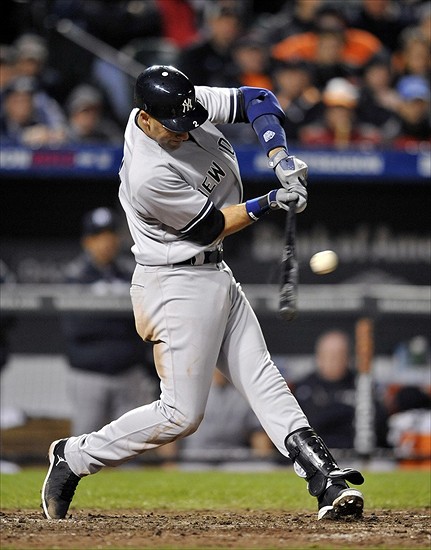
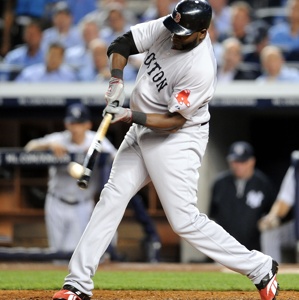
On contact, when the hitter’s arms are bent, hands closer to the body in that strong position, he is staying inside the baseball. Take a look below at four of the best hitters in the game today, and you’ll see four completely different swings, yet very similar looks on contact with regard to where their hands and arms are, in relation to their bodies.


Miguel Cabrera and David Ortiz:


Robinson Cano and Mike Trout:


If on contact, the hitter’s arms are extended, hands further away from the body, then he is not staying inside the ball. The idea of extension of the arms through the ball happens AFTER contact. Below you will see a couple pretty accomplished Major Leaguers getting caught reaching out front, not in that strong hand/arm position as shown previously.

Alex Rodriguez and Bryce Harper:


The best place to start teaching how to properly stay inside the ball is on the tee. One of the greatest benefits of the tee is the fact that the ball can be placed just about anywhere, and we can make sure that we are making contact at the correct points (the further outside, the deeper- or closer to catcher- the ball should be hit), with a fundamentally sound swing that will force hitters to stay inside the ball correctly. From there, move on to front soft toss, where hopefully they will have the feel, from working on the tee, for where they should be making contact with the ball based on the location of the pitch, and eventually, allow all of those good habits created in practice to take over in BP and the game.

Source: https://coachingyourkidsblog.wordpress.com/2013/06/12/staying-inside-the-ball-what-does-it-really-mean/

Thursday, October 29, 2015

Redefining Success: 8 Tips for Being a Great Sports Parent


“When did parenting get to be so stressful?” began a recent post on the Changing the Game Project Facebook page. “I worry that if I don’t provide them with the best equipment, or get them on the best team, or take them to every camp or tournament, then I am letting my kids down. Why do I feel so much pressure? Can’t we just let kids be kids, have some free time and still raise a successful athlete?”

Have you ever felt this way? Tired of trying to keep up with the Joneses, stressed that your kids need to be in three places at once, and just hoping for a weekend off for a family meal?

If so, you are not alone. There is a lot of pressure on parents these days. We want the best for our children and we don’t think twice about taking action when we see we’re able to fill a need. But are we doing enough? Are we giving our kids the best chance of success?

It’s enough to drive you nuts.

But what if you could do more, simply by doing less?

Well, you can.

At Changing the Game Project we believe being a successful sports parent has nothing to do with who buys the more expensive equipment. Success is not who compiles the longer list of camps and clinics, whose kid makes the “A” team at the youngest age, or who posts the most pictures of kids with trophies on Facebook.

Our definition of success is taken from the master himself, Coach John Wooden, when describing his athletes and teams at UCLA:

“Success is the peace of mind which is a direct result of self-satisfaction in knowing you did your best to become the best you are capable of becoming.”

Shouldn’t we have a similar definition for parents?

“Successful parenting is the piece of mind in knowing that you did your absolute best to become the best parent you are capable of becoming.”

Not the best parent compared to so and so, but you, the best parent you can be with the talents and resources that you have.

Be the best parent that you are capable of becoming, with all you have going on in your life.
You don’t have to do everything under the sun for your kids to be a successful parent. You don’t have to give up every weekend and every vacation. It doesn’t mean you have to get a second mortgage to send your kids to six camps next summer.  And it certainly does not mean that what team your kid makes, or how many trophies he or she wins is a reflection upon whether you are a good parent or not.

It simply means doing your best, maintaining family balance, and watching your child succeed and fail without taking it personally.

It doesn’t mean paying for more; many times it actually means doing less.

Here are eight things you can do to increase your child’s chances of finding success and fulfillment in their sport that won’t cost you a penny. The best part, though, is they will help you fulfill your role as the parent of an athlete while at the same time making it all the more enjoyable.

8 Ways to Be a Great Sports Parent

1. Model Positive Behaviors.
Be a positive role model for your child. Sport should be an extension of your familial values and behaviors, not a suspension thereof. Be an encouraging parent. Don’t talk badly about competitors or loudly second-guess the coach. It’s okay to appreciate the athletic skill of a competitor and you are not a traitor for acknowledging another athlete has talent.
There are enough uninformed critics in the stands hurling insults at kids playing a game, so instead set the example for others. You are looked at just as much by other parents as your athlete is, so be the fan your child needs you to be.

2. See the future, but enjoy the present.
Are you consistently looking towards the next level, the next team, the next season? If you are, you’re missing out on the most important game, the one being played today! If you’re not enjoying the present moment, your child will grow up before you realize it; if you don’t squeeze every ounce of enjoyment out of their development as a person, you’ll regret it.
Be a parent who enjoys the now, and let the coach be the one who is looking to the “later.” Leave them alone on the ride home from games. Take your athlete to the court and let them teach you something. Throw the ball around the yard while you swap stories and get to know the social side of each other. Lots of smiles with no judgment during fun play will relieve stress for you and your athlete and also create special bonding moments that only an athlete and their parent can share.


3. Encourage risk taking and find joy in the effort.
Competing leads to winning and losing, thus competing is inherently risky. Don’t downplay the importance and challenge of risk taking by saying “Great job out there, maybe you’ll get it next time.” That’s vague encouragement and not helpful to an athlete’s development. Instead say “I love how you really went for it out there on that one play. You didn’t get it, but I was so proud that you didn’t give up!” Strong, specific words of encouragement remind an athlete it’s okay to take a risk and fail so long as she did all she could to be successful.

4. Celebrate the competitor above the winner.
The difference between losing and getting beat is in the effort expended during competition. A competitor never loses; they get beat, and getting beat fuels the competitor to improve. In every game, there is a winner and a loser. Defeat can be the seed of discontent your athlete needs to be motivated to work harder and smarter next time.

USA's Karch Kiraly celebrates a point during the men's beach volleyball finals of the Centennial Summer Olympic Games in Atlanta Sunday, July 28, 1996.  Kiraly and teammate Kent Steffes defeated fellow countrymen Mike Whitmarsh and Mike Dodd 24-13 for the gold.

Legendary volleyball player and three-time Gold Medalist Karch Kiraly spent his teen years playing beach volleyball against grown men. He didn’t win… at first. Winning was not the goal; development was.

In the beginning, Kiraly and his partner celebrated scoring 3 points in a match. Months later, they celebrated scoring 6 points in a match. A few years later, still a teenager, Kiraly wasn’t only competing against professionals but beating professionals and winning tournaments.
When your athlete plays a level above her ability and does well, that effort should be celebrated, regardless of the result. A true competitor should always look to “play up” a level, whether in practice or on game day. The expectation should be for her to compete at the highest level she can.

Excellence breeds success; a focus upon success rarely yields excellence.

5. Foster independence by allowing your athlete to take ownership.
Autonomy is one of the three key ingredients of long term athletic success. Goals and expectations are great tools if used properly. However, if your athlete is constantly trying to live up to your expectations it could lead to her believing your happiness depends on her performance.
Believe it or not, by taking a step back, you give your child the room to step forward and claim the sport for herself.

An elite athlete experiences enough pressure to perform well from his teammates, the coaching staff, and from himself. He doesn’t need the added pressure of an overzealous parent with good intentions!
Allowing and fostering independence is critical. There’s no escaping the mean, evil-spirited opinions, the rude comments, and the difficult situations that will confront an athlete. The sooner she learns to stand on her own and not always have you to lean on or hide behind, the better.

6. Treat the coach as an ally, not an adversary.
If you treat the coach as an adversary, how do you think your athlete will treat him? You and the coach want the same thing: for your athlete to be successful (though you might see different paths to making that happen). Once you know that the coach values your child not just as an athlete, but as a person, then step back and let him or her coach. You won’t always agree with every decision, and your child may struggle at times, but instead of saying “what’s wrong with this” try “what’s good about this?” There is always learning to be had if you look close enough.

Working with your coach by keeping him or her informed, and respecting boundaries, actually gives your child the best chance of success.

7. Encourage academics.
Eventually, all athletes have to one day turn in their jersey and find a new passion. Very few elite athletes play beyond college and an infinitesimal number make decent money playing professionally. An education is not a backup plan if athletics doesn’t work out: it is the foundation from which your athlete will build a life upon, athletics or not.

8. Just love watching your kids play
Sports goes by way too quickly, so enjoy every moment. Do so by simply saying “I love watching you play.” It changes everything (watch this video if you don’t believe me).

If you have given your best, and you can say to yourself “I have done what I can while maintaining sanity, health and the well being of my family and relationships,” then by all means you are a successful sports parent.

Stop looking at Facebook, and comparing what your house looks like on the inside to what everyone elses house looks like on the outside. Simply take a step back, let the athletic journey belong to your child, and give your best effort. Just do your best, and have fun doing it.

Not only will your kids notice it.

They will love you for it!

And that is the ultimate reflection of success.

Source: http://changingthegameproject.com/redefining-success-8-tips-for-being-a-great-sports-parent/

Thursday, October 22, 2015

FIVE TIPS EVERY BASEBALL RECRUIT SHOULD KNOW

Finding a baseball scholarship can be a difficult process. Scholarships for baseball aren’t as abundant as they are in other sports, and that means learning about exactly how the baseball recruiting process works is essential.


When does the baseball recruiting process start?

1. The baseball recruiting process starts in middle school. Baseball recruiting starts early because competition for baseball scholarships is extremely high. At the Division I level there are up to 11.7 scholarships for baseball available for each school, and in Division II there are just nine baseball scholarships available for each school. The value of each scholarship means that baseball coaches have to identify recruits in the 7th and 8th grades.

How do I get discovered?

2. College coaches scout baseball recruits based on third-party evaluations from a trusted neutral source like NCSA. You may swing a sweet bat and field with a slick glove, but that doesn’t necessarily mean that you’ll be recruited by college baseball programs and get that coveted scholarship for baseball. College coaches initially identify top baseball prospects using online tools from a trusted resource like NCSA first, well before they see you display your baseball skills in person.

How do coaches evaluate prospects?

3. The Internet is your best baseball recruiting tool. College baseball coaches are busy and can’t spend all of their time at high school baseball games. The Internet makes sure they don’t have to. Easy access to video highlights and statistics from a third-party evaluator like NCSA lets coaches quickly find players that fit their system. Showcasing your skills on the Internet makes the recruiting process easier for both you and the baseball coaches you want to impress.


Where am I qualified to play?

4. Less than 2% of the nearly 500,000 student athletes that participate in high school baseball will play at the Division I level. Realize that the majority of college baseball programs aren’t in D-I, so set your expectations accordingly. More than 80% of collegiate baseball players compete at the Division II, Division III, NAIA or junior college level. NCSA is an experienced neutral talent evaluator, and can tell you exactly which level you should shoot for and where you’re likely to find the most success.


What is my coach’s role?

5. Your coach can take care of your on-the-field development, but getting a baseball scholarship is your responsibility. Ultimately, your ability is what earns you a baseball scholarship, but the recruiting process requires a lot of work off of the diamond. Your high school baseball coach is busy and has too many responsibilities to be able to dedicate the time that the recruiting process requires. There’s a good chance that you’re not the only one on your team who hopes to play college baseball, and having a high school coach manage the recruiting process for several athletes at once is just too much to ask.

Source: http://www.ncsasports.org/Five-Tips-Every-Baseball-Recruit-Should-Know?utm_source=outbrain&utm_medium=ppc&utm_campaign=baseball-hed

Wednesday, October 21, 2015

Terry Bradshaw wouldn't let son play football now

Hall of Fame quarterback and FOX analyst Terry Bradshaw has become the latest former player to say that he would not allow his offspring to play football.

"If I had a son today, and I would say this to all our audience and our viewers out there, I would not let him play football," Bradshaw said during a Wednesday appearance on NBC's "The Tonight Show with Jay Leno."

"There will be a time in the next decade where we will not see football as it is, I believe," the former Pittsburgh Steelers great said.

"I know in the state of Texas, it's king, but I believe where soccer is going to elevate itself. I think basketball and baseball (are going to become more popular) and the contact sports are going to slowly phase away. ... I would not want my child out there. ... The fear of them getting these head injuries -- and they're out there -- it's just too great for me."

Before making that statement, Bradshaw recounted all of his medical ailments, which included multiple shoulder and ankle surgeries and concussions. Bradshaw said that he had six major concussions, each of which knocked him out cold.

But he later admitted that he'd do it all again.

"Football is an awesome sport, but it's also a violent sport, and that's why all of us love it. We know what we checked in for, and at seven years of age that's what I wanted to do with my life and I didn't care that I got hurt. And then the question, 'Would you do it again?' -- Absolutely."

Bradshaw's comments go a bit further than those made earlier this year by fellow Hall of Fame quarterback and FOX broadcaster Troy Aikman, who said that football might be surpassed as the No. 1 sport in 20 years. Aikman said that while he wouldn't forbid his son from playing football, he wouldn't encourage it.

Bradshaw hasn't joined any of the lawsuits against the NFL, but thinks the litigation is forcing the league to care about former players.

"I have to be careful here because I work for FOX and NFL Network, but I don't think they care," Bradshaw said, according to the SportsBusiness Daily (via The Washington Post).

"They're forced to care now because it's politically correct to care. Lawsuits make you care. I think the PR makes you care. But personally, when I got out in 1983, do I think they cared about me? No. And you know what? I don't expect them to. I don't need them to worry about me. I take care of myself. But do they care? They're forced to care right now, because PR-wise, it's not very favorable to them."

Source: http://www.nfl.com/news/story/09000d5d829d33b9/article/terry-bradshaw-wouldnt-let-son-play-football-now

Thursday, October 15, 2015

Harvey Krupnick is the godfather of wrist hitting


Inline image 1

Harvey Krupnick is the godfather of wrist hitting, and he utilizes concise, well thought out principles to maximize the most of players talents in the hitting stroke with this concept.Krupnick is adept at teaching wrist hitting with precision and power that can be used for young kids and older players.

email: WristHitting@gmail.com for your FREE GUIDE

Tuesday, October 13, 2015

HAMMERING HANK AARON - Hank was noted for hitting home runs with a “flick of his wrists.”


Inline image 1

The backhand wrist action and top hand piston punch action combine to create the “hammer like” speed action we are all looking for in our hitters. For sure all of us have heard of “HAMMERING HANK AARON.” I wonder why he was named “Hammering Hank?” Do you think it had something to do with his wrist actions? Hank was noted for hitting home runs with a “flick of his wrists.” Gee, just a flick of the wrist can create a long home run in fact 755 of them. Now that sounds easy.
-Coach K