Thursday, October 15, 2015

Harvey Krupnick is the godfather of wrist hitting


Inline image 1

Harvey Krupnick is the godfather of wrist hitting, and he utilizes concise, well thought out principles to maximize the most of players talents in the hitting stroke with this concept.Krupnick is adept at teaching wrist hitting with precision and power that can be used for young kids and older players.

email: WristHitting@gmail.com for your FREE GUIDE

Tuesday, October 13, 2015

HAMMERING HANK AARON - Hank was noted for hitting home runs with a “flick of his wrists.”


Inline image 1

The backhand wrist action and top hand piston punch action combine to create the “hammer like” speed action we are all looking for in our hitters. For sure all of us have heard of “HAMMERING HANK AARON.” I wonder why he was named “Hammering Hank?” Do you think it had something to do with his wrist actions? Hank was noted for hitting home runs with a “flick of his wrists.” Gee, just a flick of the wrist can create a long home run in fact 755 of them. Now that sounds easy.
-Coach K

Wednesday, October 7, 2015

Tom Brady, as parent, sees changes in youth sports from his days as a kid


FOXBOROUGH, Mass. – Tom Brady has said that two of the most important things in his life are his children and his job as New England Patriots quarterback.

Those two intersected Monday morning during Brady’s weekly appearance on sports radio WEEI when he was asked by host John Dennis about his view on youth sports and the concept that everyone receives a trophy. Brady stepped out of his role as quarterback when asked about the hot-button parenting topic, saying he hadn’t thought much about it, focusing his remarks on specialization in sports.

“Youth sports, and what I remember from being in youth sports, everything was really localized. There were no travel teams … well, there were a couple, but you really had to be the top, top kids to go on those teams,” Brady said on the program.

“My parents always exposed us to different things, different sports. It was basketball when it was basketball season. It was baseball when it was baseball season. I didn’t play football until I was a freshman in high school. A lot of soccer. There were some camps, but I just played in the neighborhood in our street with all the kids we grew up with.

“It’s just different now, and I’m experiencing it with my own kids with all the organized activities that you put them in. I’ve made a comment for a while now: ‘I hope my kids are late bloomers in whatever they do.’ Because they are going to be exposed to so much at such an early time that yeah, you do worry about what their motivation may be. As they get older or if they feel like they’ve been in something for so long and it’s been hyperintense and hyperfocused for so long, I think that can wear out a young individual, a young teenager.

“It’s just hard, because all the parents are doing it, it seems, and the competition feels like it starts so early for these kids -- whether it’s to get into college or getting into the right high school or the right elementary school. I don’t know how it’s taken that turn, but you know, sometimes it’s nice for kids to just be kids. At least that’s just from what I remember from when I was growing up. I think that was a great opportunity for kids to develop lots of parts of their personality. Certainly for me, that’s what I found ultimately; I found something I love to do at a young age. But the more you’re exposed to, I think the better the opportunity is for all kids to figure out what they really want to do in life.”

Source: http://espn.go.com/blog/new-england-patriots/post/_/id/4785902/tom-brady-as-parent-sees-changes-in-youth-sports-from-his-days-as-a-kid

Monday, September 28, 2015

TEE BALL COACHING TIP: TEACHING PLAYERS TO CATCH THE BALL

The Little League® Tee Ball program is focused on bringing fun, fitness and fundamentals to its youngest players and newest volunteers. As a part of this program, Little League partnered with SKLZ to provide Tee Ball coaches with online training related to various components of the program.

This month, we take a look at teaching one of the most difficult skills for a tee baller to master - catching the ball. The online training segment below covers a three-step teaching method.

The method consists of:

Teaching the basket catch
Teaching to catch the ball with the hands up
Teaching to catch the ball with two hands

You can view this month’s online training segment by clicking on the images below.


Source & video: http://www.littleleaguecoach.org/home.aspx?article=1258

Friday, September 11, 2015

Baseball Swing Mechanics: Cocking of the Wrists

Cocking of the wrists is an action the hands perform on the bat-handle at the very end of the loading phase and into the first part of the launching phase.  It’s purpose is to break inertia, or prevent the bat from coming to a dead stop, so as to facilitate a rapid recoiling effect with the bat-head at the end of the player’s furthest backswing.

Now up until this point of the swing, the wrists and hands have not produced any significant action on the bat-handle, and subsequently the bat-head, other than holding the bat in a steady and firm position.  But the batter’s body and hand positions shown in Figure 2-40 is an important reference point because this is where the action of the hands and wrists begin to take effect on the bat handle.  Or in other words, this is where the cocking of the wrists begins.
Now as I just mentioned earlier, the purpose of the cocking of the wrists is to break inertia, or prevent the bat from coming to a dead stop, so as to facilitate a rapid recoiling effect with the bat-head at the end of the player’s furthest backswing.   So, let’s define our next reference point, and that is, the player’s further backswing.

As we watch the swing develop in Figures 2-41a through 2-41d we can now see that the player’s furthest backswing ends in Figure 2-41d.
The furthest backswing position is simply a point in the swing where the head of the bat does not travel any further away in the opposite direction of the intended path of the swing. It also represents the position where the cocking of the wrists ends or where the wrists are fully cocked.
So to recap here a bit, let’s again focus on these two bat-head positions side by side.  Notice the position of the bat-head in Figure 2-42a where the cocking of the wrists begins, and now notice the position of the bat-head in Figure 2-42b where the cocking of the wrists ends.


Now that we have seen the two different bat-head positions that define the starting and ending positions where cocking the wrists takes place, let’s take a closer look at the action that the hands and wrists have on the bat-handle that makes this happen.

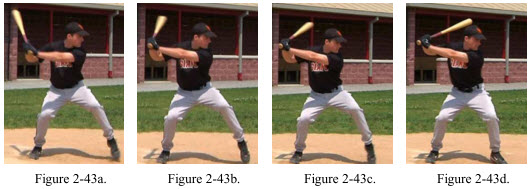
We will focus our attention first on the player’s right hand shown again in Figures 2-43a through 2-43d.  The main action that the right hand and wrist are performing on the bat handle during this movement is called pronation, which interestingly enough, occurs through muscles acting in the forearm near the right elbow and wrist.  And so the correct name for this movement seen in the right hand and wrist is called elbow pronation.

It is by pronating the right elbow where the right hand and wrist turn so that the palm of the right hand starts to turn inward toward the ground and this helps to push the bat-head to its furthest backswing position.  See Figure 2-44.


Now keep in mind that this is a relatively small movement taking place in comparison to what the shoulders and upper arms are going through and so you may not pick up on it the first time by simply looking at the right hand and wrist.  However, there is just enough of this pronation taking place in the right elbow to cause the right hand and wrist to turn so that the palm of the right hand starts to turn in toward the batter and this helps to push the bat-head to its furthest backswing position.
The muscles involved with elbow or forearm pronation are the Pronator Teres and Pronator Quadratus.   See Figure 2-45.


Now let’s focus our attention on the player’s left hand in Figures 2-46a through 2-46d.  The main action that the player’s left hand and wrist are performing on the bat-handle during the cocking of the wrists is called radial deviation.

Radial deviation is a movement that occurs within the wrist where the entire hand moves toward the thumb.  You may also think of it as trying to get your hand and thumb to move in a direction where the thumb tries to touch the side of your forearm as seen by the arrow shown in Figure 2-47.

It is by radially deviating the left hand and wrist that helps to bring the bat-handle, and consequently the bat-head, to the player’s furthest backswing position.

And just like the right hand and wrist, keep in mind that this is a relatively small movement taking place in comparison to what the shoulders and upper arms are going through and so you may not pick up on it the first time by simply looking at the left hand and wrist.  However, there is just enough of this radial deviation taking place to help move the bat-head to its furthest backswing position.

The muscles involved with radially deviating the left hand and wrist are the Extensor Carpi Radialis Longus, Extensor Carpi Radialis Brevis, and Flexor Carpi Radialis.   See Figure 2-48.

The contraction of the elbow pronators in the right forearm and radial deviators in the left wrist moves the bat-head to the player’s furthest backswing position.  What this movement does is temporarily loads, or stretches, the antagonistic muscles in the right forearm, which are the right elbow supinators, and in left wrist, which are the left ulnar deviators, just long enough so that the player can time the stretching in these muscles, and subsequent contracting of them, to add extra momentum and power to his swing.  See Figures 2-49a through 2-49d.

This is what is known as the myotatic reflex which is a muscle contraction in response to it first being rapidly stretched, i.e., loaded.  It is a very powerful reflex within the muscle that can significantly increase the speed and strength in which it contracts.  This is because it essentially adds a ‘running start’ in the direction of the intended path of contraction.

Now the myotatic (stretch) reflex is only usable for about a half of a second or less after a muscle has been stretched and then it dampens out, or weakens, and is no longer available.  So the key to using this reflex within a stretched muscle, such as what takes place during the cocking of the wrists, is to time it at the precise moment that you need it.

Now these stretch reflexes occur not only in the muscles involved with cocking the wrists, but in every other muscle that was stretched so far during the loading (stretching) phase.  This includes the muscles around both shoulders that were stretched during the backward movement of the shoulders and arms, the lateral spine rotators during the backward rotation of the spine, the hip extensors, knee extensors and ankle plantar-flexors during the beginning of the timing step and the external hip rotators during the cocking of the hips.

So these stretch reflexes play a very significant role in your ability to swing the bat harder and faster.  Simply put, you couldn’t swing the bat very hard or fast without them.  And since they are only available within the muscle for less than a second, the timing of their creation and use is not only essential to making contact with the ball, but doing so with power.

Source: http://baseballswingmechanics.com/06a-cocking-wrists-text/

Friday, September 4, 2015

Drill: One Knee Hitting

For years I have believed in one knee hitting drills. Today I am going to break down why hitting drills off of one knee are so important for understanding rotational mechanics.
Picture


Watch this video through once, then watch it again. Pause the video at Pedroia's point of contact. This picture you are looking at looks exactly like the one knee hitting drill I have all of my players execute daily. The goal of the one knee hitting drill is to focus on getting your back hip and shoulder squared up to the baseball.

The reason one knee hitting drills are so important for  amateur players to execute daily is because it teaches you how to turn. Like I said in the last article, most 21st century hitters completely disconnect their arms from their lower half which produces slow, all-arm swings. The goal of hitting is to get your back hip, knee and shoulder squared up to the baseball. When we get our back hip and back knee squared up to the baseball we are using the big muscles in our body to produce bat speed.

Watch the Pedroia video one more time. Take a look at his frontside at the point of contact. His frontside is completely locked and solid in the ground. This solid frontside is what allows Pedroia to turn his back hip, back knee and back shoulder around to get them squared up to the baseball.

The one knee hitting drill is crucial for understanding how to turn and stay connected throughout. The back elbow should naturally tuck to the body for a tight turn. Figure skaters are a great example of how to stay connected throughout a turn. When competitive figure skaters are turning slowly, their arms are extended. When they want to get a high score or win a competition, they tuck their arms close to their body and can now spin a whole lot faster. The same is true in baseball. The back elbow must tuck to the body in for a tight, efficient turn to the point of contact. Take a look at the examples below. Stay connected so centrifugal force does not force you to just throw your hands.
PicturePicture

When on a knee, hitters will find that if they just throw their hands they will produce no bat speed. After 15-20 reps off a knee, most amateur players begin to feel what rotational hitting is like. Usually amateur players start out by rolling over the first couple reps because they are used to going to get the baseball with their hands instead of turning their body as one. Variations of the one knee drill include just using a top or bottom hand.

The analogy I give all of my students is that of a boxer. A boxer's punch, if fully extended, is no where near as powerful as a jab (close to the body). I tell all of my players to let the baseball travel to "throw the jab". The power in hitting, just like in boxing, is close to your body. The farther out we reach to punch or swing, the less power and bat speed we will have. One knee hitting drills teach hitters to let the ball travel because if you go out and hit the ball with your hands you will have a 'ground ball' type round.

Source: http://www.coresavvybaseball.com/core-savvy-articles/csb-live-or-die-by-one-knee-hitting

Friday, August 21, 2015

Shorten Your Swing with One Handed Drills

Having a short, compact swing is vital to a hitter’s success. Among other benefits, having a short swing enables the hitter to start their swing later, which can lead to better two-strike hitting, better opposite field hitting and more success with off-speed pitches.

As players get older, they will face better pitching which will require sound hitting mechanics. The sooner youth hitters develop a consistent short stroke, the better positioned they’ll be for long term success at the plate. Here is one great set of drills to establish the proper muscle memory for a compact swing.

One-Handed Drills

One-Handed Drills are ideal for promoting a short swing because in order to perform the drills effectively, the hitter has to swing the bat correctly. This drill is just like any basic soft toss drill, but the batter will only swing the bat with one arm. The goal is make sure each hand takes as short a path to the ball as possible.

Have the hitter use a shorter, lighter bat than they are used to. If the bat is too heavy, it will put stress on the shoulders and it will be very difficult to do the drill. The hitter will assume his normal batting stance. Have the hitter start off with the bat in their lead (bottom) hand, with their other hand pressed against their chest for balance. For better control, have the hitter choke up.

The tosser should be positioned about six feet away, at an angle. The tosser should throw the ball right around the hitter’s front hip. The hitter will try to hit the ball right back up the middle, using their normal swing. Do three sets of five swings each . As a coach, look for the hitter to keep his lead elbow down and keep the barrel of the bat above his hands.

Next, have the hitter switch hands so the bat is in their top hand. The key here is to make sure the hitter is not throwing their top hand too far out, or “casting” the bat. Again, the focus should be on a short, direct path to the ball with no wasted movement. Do three sets of five swings each.

Variations - Isolate the Hands

Taking this drill a step further, have the hitter drop to one knee when swinging with the bottom hand. It helps to drop the front knee – this will keep the shoulder in proper position. By taking the lower body out of the drill, you will further isolate the hands to focus on a short path to the ball. Keep the repetitions consistent as before. For the top hand swing, have the hitter drop to both knees. This will make it easier to perform the drill. After completing the one-handed drills, work in some regular soft toss so the hitter can put it all together.

Practicing these drills on a regular basis will give the hitter a feel for the proper hand path and will develop muscle memory to be short and quick to the ball. And that will provide a foundation of good hitting for years to come.

Source: http://www.hittingworld.com/Shorten_Your_Swing_with_One_Handed_Drills_p/art32.htm